
Expanding impact: the multi-hub model in Armenia
Beyond the capital, Impact Hub Armenia’s multi-hub model decentralises opportunity and connects diverse regional communities, demonstrating how a network can adapt a global vision to create profound local impact.
- Impact Hub Yerevan
For many countries, economic and social opportunities are disproportionately concentrated in capitals. Armenia is no exception. Yerevan has long been the centre of resources, networks, and infrastructure, leaving other regions underserved. To build a truly inclusive and resilient future, this imbalance needed to be addressed.
At Impact Hub Yerevan, we recognised that the global vision of entrepreneurship and innovation could not remain confined to the capital. Our solution was bold: a multi-hub model that brings the power of our Network directly to the regions that need it most. By expanding into Syunik (2022) and Gyumri (2023), we are not simply opening new spaces. We are creating vibrant, locally grounded ecosystems that empower impact makers where they are, while remaining connected to the strength of the national and global Impact Hub Network.
Communities in Syunik and Gyumri face distinct challenges, from border vulnerabilities in Syunik to economic hurdles in Shirak. Opening Impact Hubs in these regions has allowed us to establish trust, respond to local needs, and build ecosystems that are both resilient and relevant to their specific contexts.
Scaling with purpose
The rationale for this model was clear. Regional entrepreneurs and innovators faced barriers: distance, administrative challenges, and a lack of infrastructure, which limited their ability to participate in Yerevan-based programmes. This meant they were cut off from resources that could help them thrive. The multi-hub model was designed to bridge this gap, providing local spaces for collaboration and tailoring programmes to meet regional realities.
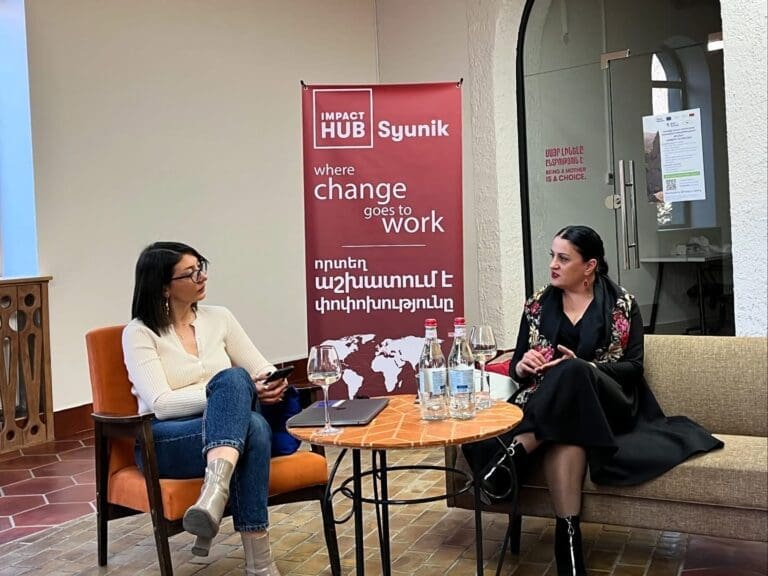
The results are tangible. In just two years, Impact Hub Syunik has become a dynamic centre for entrepreneurship and community building, supporting 94 enterprises and welcoming over 2,400 guests. Community events like AgriFest and the Christmas Bazaar have created new economic and cultural touchpoints, embedding the Hub in the social fabric of the region.
Meanwhile, Impact Hub Gyumri has revitalised Shirak’s creative and entrepreneurial scene. Initiatives such as ArtInsight and CRELAB Shirak blend cultural expression with skill-building, positioning the Hub as both a cultural catalyst and an innovation platform.
Each Impact Hub serves its community’s unique needs while benefiting from the networks, experience, and stability of Impact Hub Yerevan. Together, they form an interconnected system that multiplies opportunities and accelerates impact.
A blueprint for networked resilience
Building a culture of coworking and community-driven innovation in regions outside capitals is not a short-term endeavour. It requires patience, mindset shifts, and sustained investment. Yet the momentum in Syunik and Gyumri shows that this approach works, and that demand for training programmes, entrepreneurial support, and communal spaces is real and growing.
The multi-hub model in Armenia is more than a national success story. It is a blueprint for networked resilience. It proves that impact deepens when decentralised, that innovation flourishes when rooted in local realities, and that a global vision becomes stronger when adapted to diverse contexts.
By bringing the global Impact Hub framework into Armenia’s regions, we are building bridges, empowering impact makers, and shaping a more resilient future, one region at a time.
Unleash your impact potential today
Join our free global membership for the latest news, resources, and inspiring stories of entrepreneurial impact. Sign up now and ignite your journey towards making a difference.
You also might like
5 inspiring initiatives committed to inclusivity in our Network
Closing the coordination gap: A guide to systems change through ecosystem building